Adult affiliate programs don’t all pay the same way, and they don’t all suit the same traffic. Two offers showing the same headline percentage can leave you with wildly different amounts at the end of the month, depending on how they attribute sales, how often they pay, and whether the user you send keeps generating income or vanishes after the first click.
This guide doesn’t rank brands or tell you which one to join. It does something more useful: it gives you the criteria to judge any program yourself, read the fine print like a seasoned webmaster, and keep the one that fits your traffic source, your geos, and the way you work. You make the call at the end; this is what to weigh it against.
Start with your traffic, not the percentage
The most expensive mistake in this business is choosing by the big number on the homepage. A 45% that takes ninety days to clear and demands a high threshold can pay out less than a 20% lifetime share collected twice a month. Before you look at a single offer, pin down three things about your traffic:
- Source: where it comes from (SEO, forums, communities, tubes, paid media buying).
- Geos: which countries and language it belongs to, because the same user is worth different amounts by geo.
- Behavior: whether it returns and matures, or it’s one-touch and high volume.
With those three answers you can already rule out half the programs without reading another condition. The rest of this guide is how to evaluate the one that’s left.
The commission model: your first decision
How a program pays matters more than what it advertises. Most of the adult space uses four structures, and many programs offer several so you can pick per campaign.
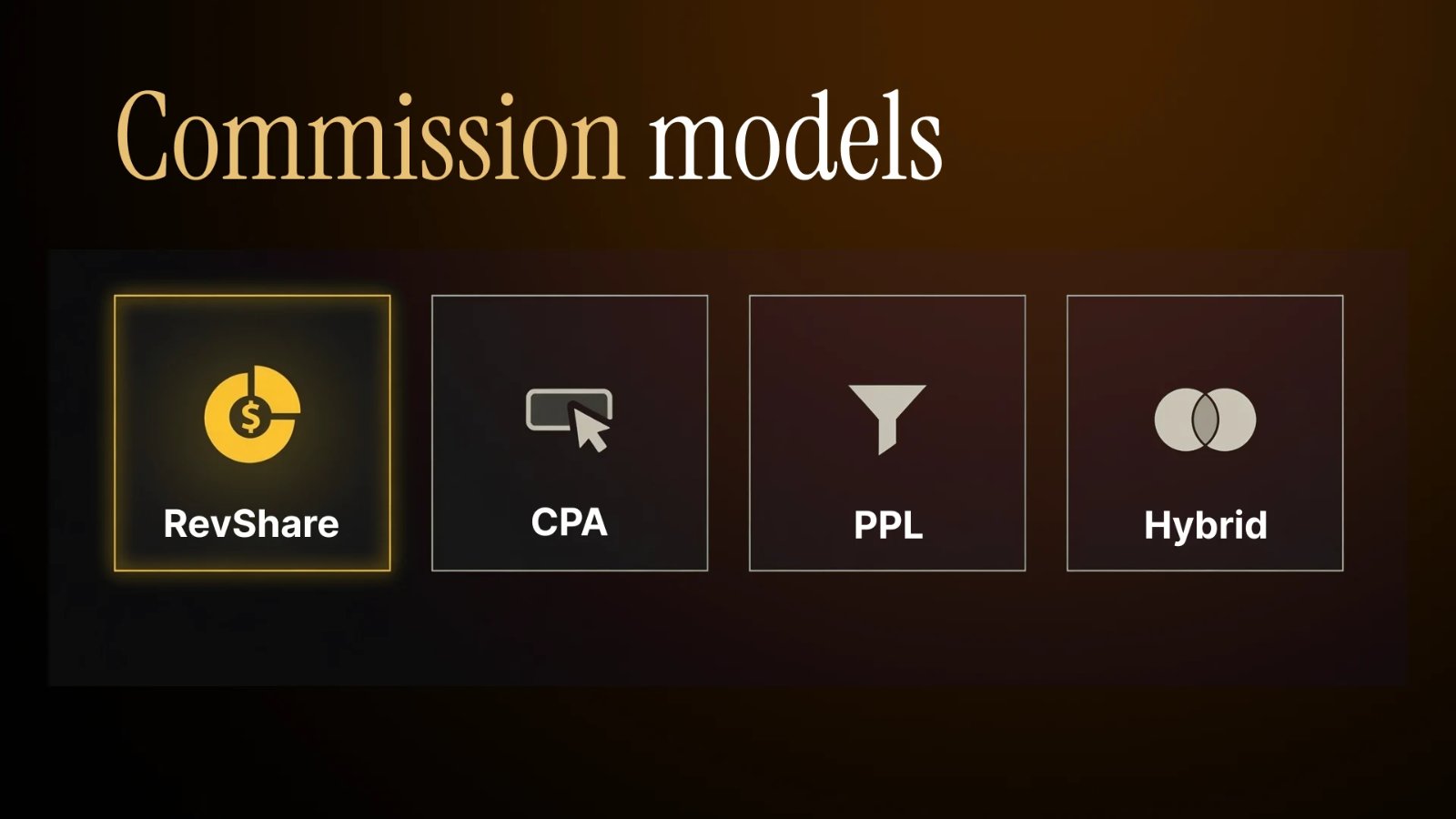
RevShare (revenue share)
You earn a percentage of what your referred user spends, on a recurring basis. If the revshare is lifetime, you keep earning as long as that user spends, with no expiry. It rewards quality traffic and retention: a signup today can still pay you two years from now. It’s the natural fit for verticals built on recurring spend.
PPS / CPA (pay per sale or action)
You earn a fixed amount each time your user completes a specific action: first purchase, subscription, or qualified signup. It delivers immediate, predictable income, ideal for high-volume traffic and media buying, but you don’t benefit if that user later becomes a big spender.
PPL (pay per lead)
You earn a flat fee for each valid signup, usually with a confirmed email and adjusted by country tier. It converts with less friction because the user doesn’t have to pay yet, but the value per lead is lower and some programs filter hard on quality.
Hybrid models
These mix an upfront payment (PPS or PPL) with a smaller revshare. They cut risk and smooth out cash flow: you get something up front and still share in future spend. It’s common once you’re generating volume and negotiating terms with a manager.
Rule of thumb: if you send high-spend, recurring users, prioritize lifetime revshare; if your traffic is high-volume and one-touch, PPS/CPA pays out faster. Match your source to the model before you sign up:
- SEO or niche blog → lifetime RevShare: high intent, users who retain well.
- Forums and communities → RevShare or hybrid: an audience that matures over time.
- Messaging and groups → lifetime RevShare: repeat contact and accumulated trust.
- Tubes, pop or mass display → PPS / CPA: high volume, fast conversion, low retention.
- Paid media buying → PPS or hybrid: you need to recover ad spend fast.
The numeric examples in this guide are illustrative: they’re there to reason with, not figures from any specific program.
Payment terms: where your real margin is decided
Two programs with the same percentage can leave you with very different amounts depending on how and when they pay. It’s the boring part, and it’s also what separates real income from a pretty number in the dashboard. Check three things:
- Frequency: how often they pay. The norm runs from weekly to monthly. Getting paid twice a month speeds up your cash flow versus a monthly cycle, which matters a lot if you reinvest in paid campaigns.
- Payout minimum: the balance you have to accumulate before you can withdraw. A high threshold with slow payments delays your reinvestment and makes scaling harder. On small traffic, a reasonable minimum is the difference between getting paid this month or next.
- Methods: pick a method that exists in your country and whose fee doesn’t eat your margin. An expensive international wire weighs heavily if you cash out near the minimum. Check which currency you’re paid in and who absorbs the exchange.
Always ask about withdrawal fees. A high advertised percentage loses its shine once you deduct payment costs on every cash-out.
Tracking, cookies, and attribution
Attribution decides who gets credit for a conversion and for how long. It’s what determines whether you get paid for the sales you actually generated or only the ones that fall inside a narrow window. Look at:
- Cookie length: how long the cookie that ties the user to you lasts. A short window makes you lose legitimate conversions that arrive days after the first click.
- Conversion window: whether an already-registered user who returns via another channel still credits to you.
- RevShare duration: whether it’s lifetime or expires after X months. A revshare that switches off at six months is not the same as one with no limit.
- Reporting quality: a dashboard that shows clicks, signups, and sales close to real time, with tracking links and subids to separate campaigns. Without per-source data you can’t optimize.
If anything about attribution is unclear in the terms, ask the manager before you send traffic, not after.
Niche and geo fit
A great program in the wrong niche converts poorly. Check that the catalog and content type match what your audience expects when they click, and that the brand is strong precisely in your countries. A Southern European user arriving for content in their own language converts far better on an offer built for that geo than on a generic English one. Look too at which languages the platform supports, whether the end user’s payment methods exist in their country, and whether the price feels reasonable in that currency.
Creative quality
Creatives (banners, landing pages, links, feeds) are the tools you work with every day. A good program offers up-to-date material in several formats and languages, plus landing pages that load fast and convert on mobile. Signs the material is good:
- Banners and widgets in current sizes, not assets from five years ago.
- Landing pages built for mobile and for your geos’ languages.
- Deep-link support to a specific page, not just the homepage.
- In-house tools (feeds, link generators, dynamic content) that save you work.
If the material is outdated or there are only English banners, your conversion pays for it even when the percentage is high.
Support and reliability
Behind a good program there are people who answer. An accessible affiliate manager settles attribution questions, negotiates terms once you generate volume, and warns you about changes before they hit you. Look for real support through a direct channel, not just a form nobody replies to. On payout reliability, weigh the payment history, how transparent the terms are, and how long the program has been operating. A sector reputation is built by paying on time, and it shows when you ask other affiliates.
Red flags
Some patterns are worth treating as warning signs. None is definitive proof of anything, but several together are reason to be cautious:
- Huge headline percentages with no explanation of how they’re reached or under what conditions.
- Very high payout thresholds combined with slow payments: a common way to hold onto your balance.
- Vague or shifting attribution terms, or absurdly short cookie windows.
- An opaque dashboard that doesn’t break out clicks, signups, and sales by source.
- Nonexistent support, or replies that take weeks even before you sign up.
- Clauses that let them void commissions on quality grounds with no clear criteria or right to review.
- Pressure to send volume now, with aggressive bonuses that cloud the real payout terms.
A checklist before you sign up
Before opening an account, run the program through this quick filter:
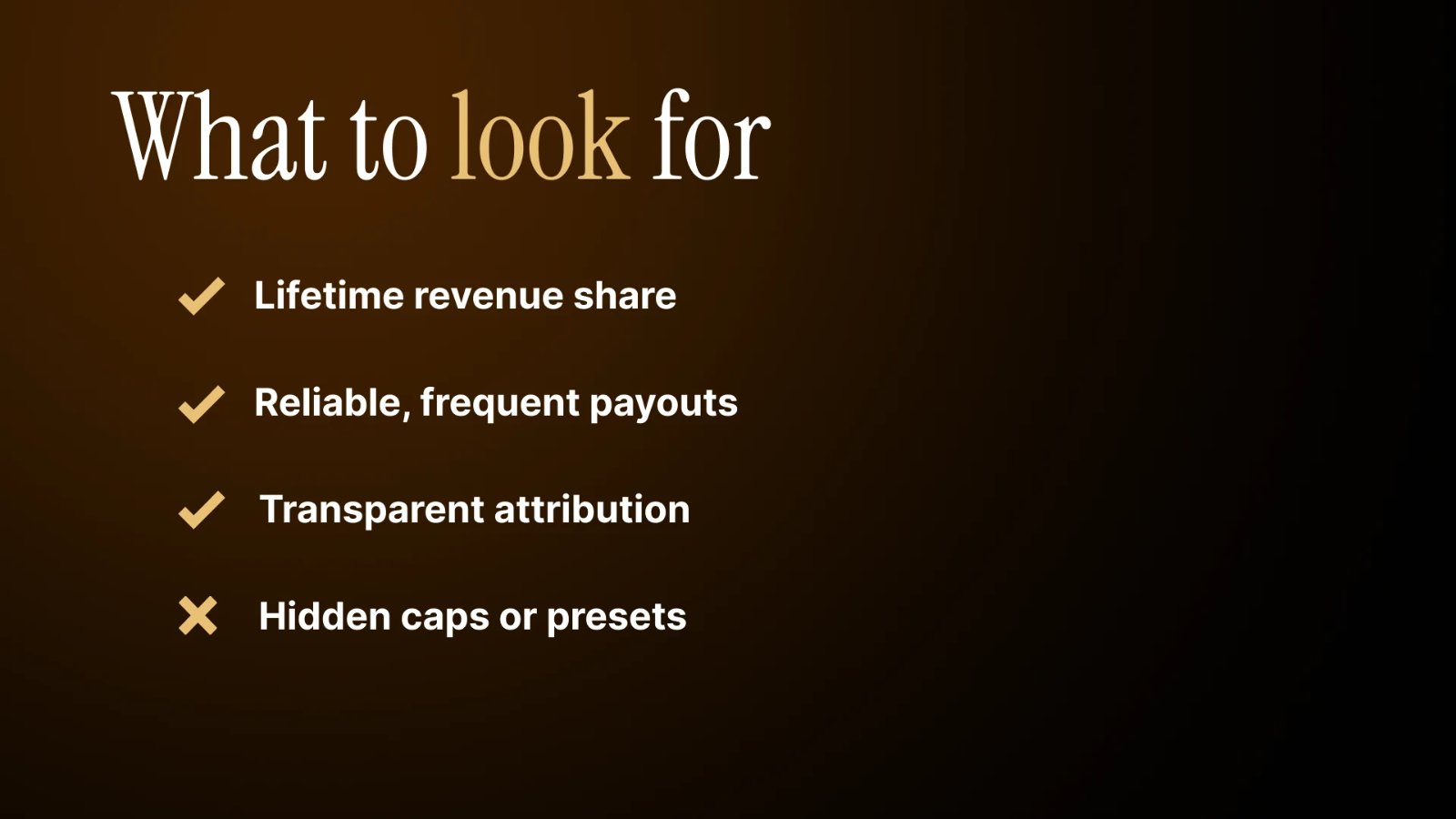
- Commission model. Does it fit your traffic? Is there lifetime revshare if your audience retains?
- Payments. Frequency, minimum, methods available in your country, withdrawal fees.
- Attribution. Cookie length, conversion window, and whether the revshare expires.
- Niche and geos. Is the brand strong in your countries and languages?
- Creatives. Current material, mobile-ready, in your languages, with deep links.
- Support. Is there an accessible manager through a direct channel?
- Reliability. Payment history and transparency of terms.
FAQ
RevShare or CPA?
It depends on your traffic. RevShare if you send high-spend, recurring users, because you earn while they spend. CPA if your traffic is high-volume with immediate conversion but low retention. Many affiliates run both depending on the campaign.
What does lifetime revshare mean?
You keep earning your percentage on everything the referred user spends for their entire life on the platform, with no time limit. A signup today can still generate income two years from now.
What should I check first when comparing programs?
How they pay, not how much they advertise. Match the commission model to your traffic, review frequency, minimum, and payout methods, and check attribution. The headline percentage comes last, not first.
How many programs should I run at once?
Just enough not to dilute your traffic. Splitting the same source across five offers usually ends in optimizing none of them. Better to concentrate where it truly converts and test alternatives in an orderly way.
How do I know a program actually pays?
By its track record and transparency. Clear terms, a manager who responds, a dashboard that shows per-source data, and time in operation are better signals than any homepage percentage.
Conclusion
Choosing a program is an economic decision, not a branding one. Start from your traffic, match your source to the commission model, verify payments and attribution in the actual terms, and prioritize recurring income if your audience is loyal. The homepage percentage is the least reliable figure of all; what counts is how much ends up in your account and how promptly. With the checklist above you can judge any offer without anyone selling it to you.
An example of those terms in practice: Amateur Cash, the official program of Amateur.tv (a cam site focused on real amateur content), pays 20% lifetime revshare, with payments twice a month and a $100 minimum. It fits especially well when your traffic is amateur, Spanish-speaking, or from Southern Europe and you want recurring income rather than a single spike. You can review the terms at amateur.cash/en or reach out on Telegram at @amateurtvcash.